
Williston's Waterproofing and Air Barrier Specialists
Not a contractor applying sheet membranes to foundation walls and calling the moisture problem solved. A foam-based waterproofing and air barrier operation built on highway construction experience, multi-rig capacity, and the building envelope knowledge that Williston's extreme cold, Arctic wind exposure, and energy sector construction standards actually demand.
Why Choose Technical Construction Solutions for Waterproofing and Air Barriers in Williston, ND?
A project manager I spoke with at an industrial services facility off the US-85 corridor had been dealing with recurring moisture infiltration in a lower-level mechanical room for two seasons. The building was relatively new, built during the Bakken boom years when Williston's construction pace pushed some envelope work through faster than the conditions warranted. A waterproofing contractor had been out twice. Both times, the repair held through summer and began failing again before December.
When we walked through the building, the problem was not difficult to read. The foundation membrane work was visible and appeared intact on the sections that had been treated. What had not been addressed was the air infiltration pathway at the rim joist running the full perimeter of the building, and the wall-to-foundation transitions at two mechanical penetrations where the original installation had left gaps that no amount of foundation wall treatment was going to close. Williston's flat Bakken terrain gives northwest Arctic winds a completely unobstructed run at every building surface. Those penetration gaps were not minor oversights. In January, with sustained wind pressure against the north wall, they were the primary moisture entry pathway in the building, and the treated foundation wall above and beside them had done almost nothing to change that.
We came back in with spray foam at the rim joist, the wall-to-foundation transitions, and both mechanical penetrations, and applied a spray-based exterior membrane to the two foundation sections that had been previously patched without proper substrate preparation. The project manager reported that the following winter was the first since the building was completed where the mechanical room did not show condensation on the lower wall surfaces by mid-November.
That result is not unusual in Williston. It is what happens when the crew assessing a building understands how Arctic wind pressure and frost cycle moisture movement actually enter a structure in this specific market, not just which surfaces look like they need treatment.
Technical Construction Solutions was founded by Freddy Lewis, who grew up in a highway construction family and spent more than fifteen years in large-scale field construction, including highway undersealing and below-grade infrastructure work. That foundation gives TCS a building system perspective on moisture and air infiltration that most waterproofing contractors in the market do not carry, establishing us as a highly specialized Williston spray foam insulation contractor option.
If your Williston building has recurring moisture infiltration, previous waterproofing work that failed before the second winter, or a new construction project where the building envelope needs to meet energy sector performance standards from the first day of occupancy, a free estimate is the right starting point.
Waterproofing Services in Williston, ND
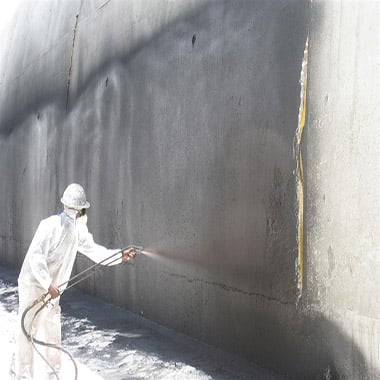
Below-Grade Foundation Waterproofing
For residential, commercial, and industrial structures across Williston, Tioga, Ray, and the surrounding Williams County area, below-grade foundation waterproofing stops moisture at the point where Bakken formation soil behavior, hydrostatic pressure, and freeze-thaw cycling create the most consistent stress on a foundation assembly.
Williston's position on the Bakken formation creates foundation moisture conditions that differ from other North Dakota markets in specific ways. Frost heave sensitivity is more pronounced here than in many areas of the state. The ground disturbance from industrial activity in the basin affects sub-base moisture movement near active facilities, and the freeze-thaw cycles that Williams County's winters produce stress foundation wall materials and membrane transitions through repeated expansion and contraction that moderate-climate waterproofing systems are not designed to handle at this frequency.
Below-grade waterproofing on new construction in Williston starts with a spray-applied or sheet-applied membrane bonded to the foundation wall before backfill, combined with a drainage plane and protection board that keeps the membrane intact as Bakken soil cycles through its seasonal movement. Getting those details right at the construction stage costs a fraction of what remediation costs after backfill is in place and moisture damage has started appearing on interior surfaces.
On existing structures where the foundation face requires remediation, the first step is identifying where moisture is actually entering and how it is moving through the building assembly. A wet interior surface is the endpoint of that movement, not the entry point. Treating the interior surface without tracing the pathway back to the exterior entry point produces repairs that hold until the next frost cycle reloads the same pathway.
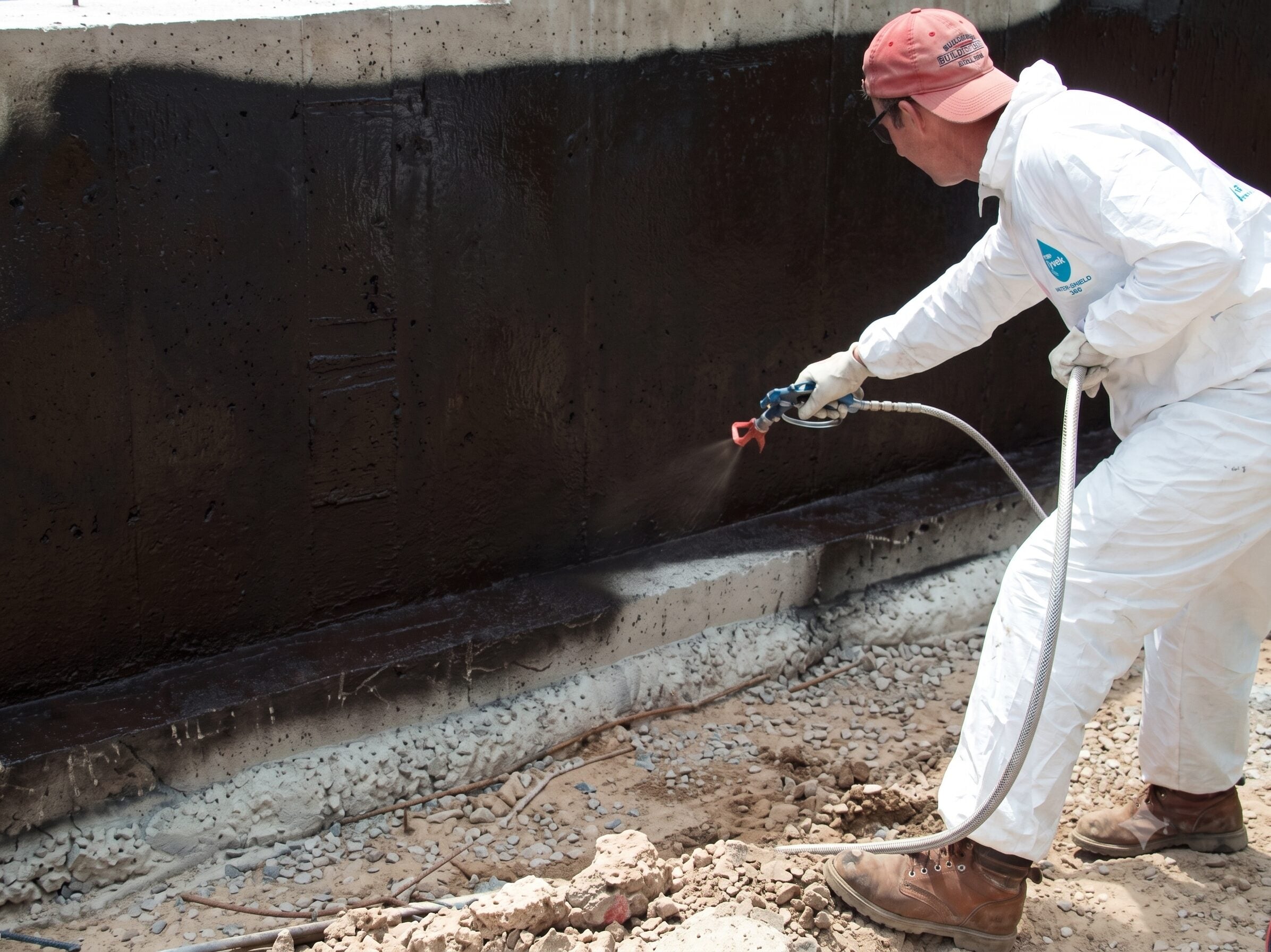
Spray-Applied Foundation Waterproofing Membranes
For foundation walls that require continuous, fully adhered coverage across irregular surfaces, penetrations, and wall-to-footing transitions, spray-applied waterproofing membranes deliver results that brush-applied sealers and sheet systems cannot match on complex geometry.
A spray-applied membrane bonds directly to the substrate and cures into a seamless film across the full treated area, including the transitions, penetrations, and corner details where sheet systems leave gaps and brush-applied products leave thin spots. In Williston's climate, where freeze-thaw cycling stresses every material transition on a foundation wall repeatedly across a heating season that runs from October through April, that continuity is what separates a system that holds from one that begins failing at the details within the first two winters.
Membrane system selection is based on substrate condition, hydrostatic exposure, and the specific frost cycle performance requirements of the Williston climate zone, not on what product is fastest to apply. A membrane applied correctly to a properly prepared substrate in a Williston frost environment lasts significantly longer than one applied quickly to a surface that was not ready to receive it.
Foundation Drainage and Moisture Management
Waterproofing membranes perform best when drainage is managed correctly at the foundation perimeter. A membrane holding water against it under sustained hydrostatic pressure from spring snowmelt and Bakken soil moisture cycling faces a fundamentally different performance challenge than one with a properly graded drainage plane moving water away from the wall face before it has sustained contact with the membrane surface.
For residential and commercial projects across Williston, foundation drainage systems, perforated drain tile, drainage board, and properly graded backfill work alongside the waterproofing membrane to reduce the hydrostatic load on the wall. Addressing drainage and membrane together at the same time is significantly less expensive than correcting drainage after the membrane has already been stressed through multiple Bakken winters, and the remediation scope has grown beyond what the original installation would have cost.
Air Barriers and Foundation Moisture Control in Williston, ND
A properly waterproofed foundation can still develop recurring moisture problems if air infiltration is carrying cold outside air and frost-loaded soil air into the building assembly through gaps in the above-grade envelope. In Williston, foundation moisture and air infiltration are not separate problems. They share entry pathways, and addressing the foundation membrane without closing the air infiltration routes above it produces results that fail when Arctic wind pressure loads the building envelope from November through March.
How Williston's Wind Environment Makes Air Infiltration a Structural Threat
Williston's flat Bakken terrain gives prevailing northwest winds a completely unobstructed approach path to every building surface in the region. There is no topographic relief, no treeline dense enough to reduce sustained wind pressure at building envelopes the way forest cover does in other North Dakota markets. In January, that wind arrives at wall surfaces, rim joists, penetrations, and wall-to-foundation transitions with pressure that is effectively continuous through the heating season.
Air moves from high pressure to low pressure through every gap it can find. In a Williston building during winter, the stack effect creates negative pressure at the lower levels simultaneously with wind-driven positive pressure at the windward wall surfaces, drawing outside air inward through the rim joist, below-grade penetrations, and wall-to-foundation transitions with sustained force. That air carries moisture with it, and that moisture condenses on cold interior surfaces within the wall assembly and lower-level framing.
A foundation wall that has been correctly waterproofed at the exterior face can still show moisture damage on interior surfaces by mid-winter if the air infiltration pathway through the rim joist and wall-to-foundation transition above it has not been closed. This is one of the most common and expensive misdiagnoses in Williston building envelope remediation: treating the foundation wall while leaving the air entry points open directly above it.
Spray Foam Air Sealing at the Foundation Level
Spray foam applied to the rim joist, the wall-to-foundation transition, and below-grade penetrations stops air movement at the building envelope plane, where Williston's Arctic wind pressure and stack effect create the most sustained infiltration pressure through every heating season.
The foam bonds directly to framing and foundation material, fills irregular gaps that no other air sealing method addresses reliably, and provides insulation value at the rim joist, one of the highest heat-loss locations in any Williston building envelope. For new construction in the Williston area, spray foam air sealing at the foundation level is the detail that produces a measurable difference between a building whose heating system runs at capacity all winter and one that holds temperature efficiently through conditions that push below minus twenty. For retrofit projects, it is often the single correction that resolves recurring lower-level moisture problems that previous membrane treatments failed to address because they were applied to the wrong surface.
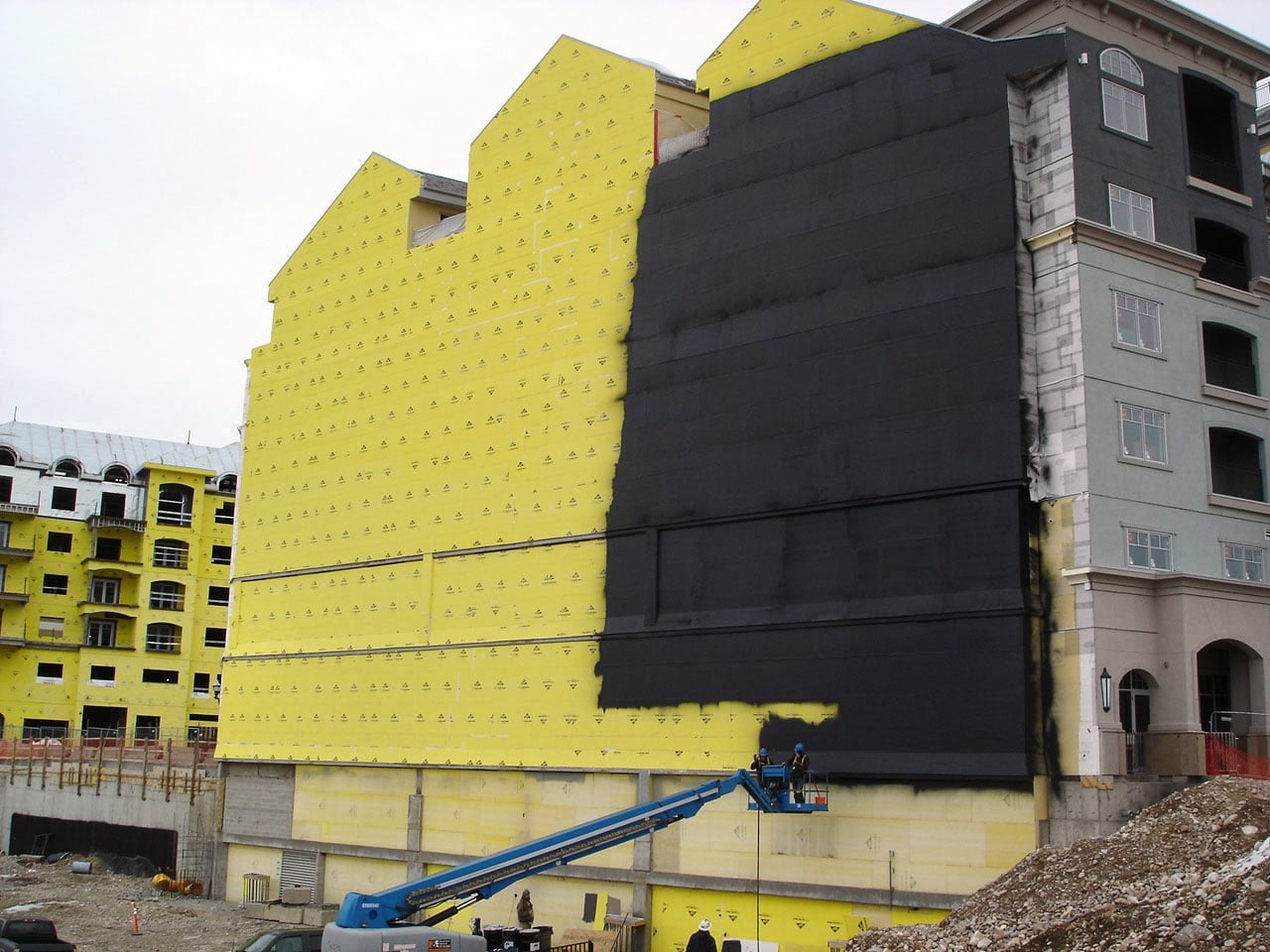
Spray-Applied Air Barriers for Williston's Commercial and Industrial Buildings
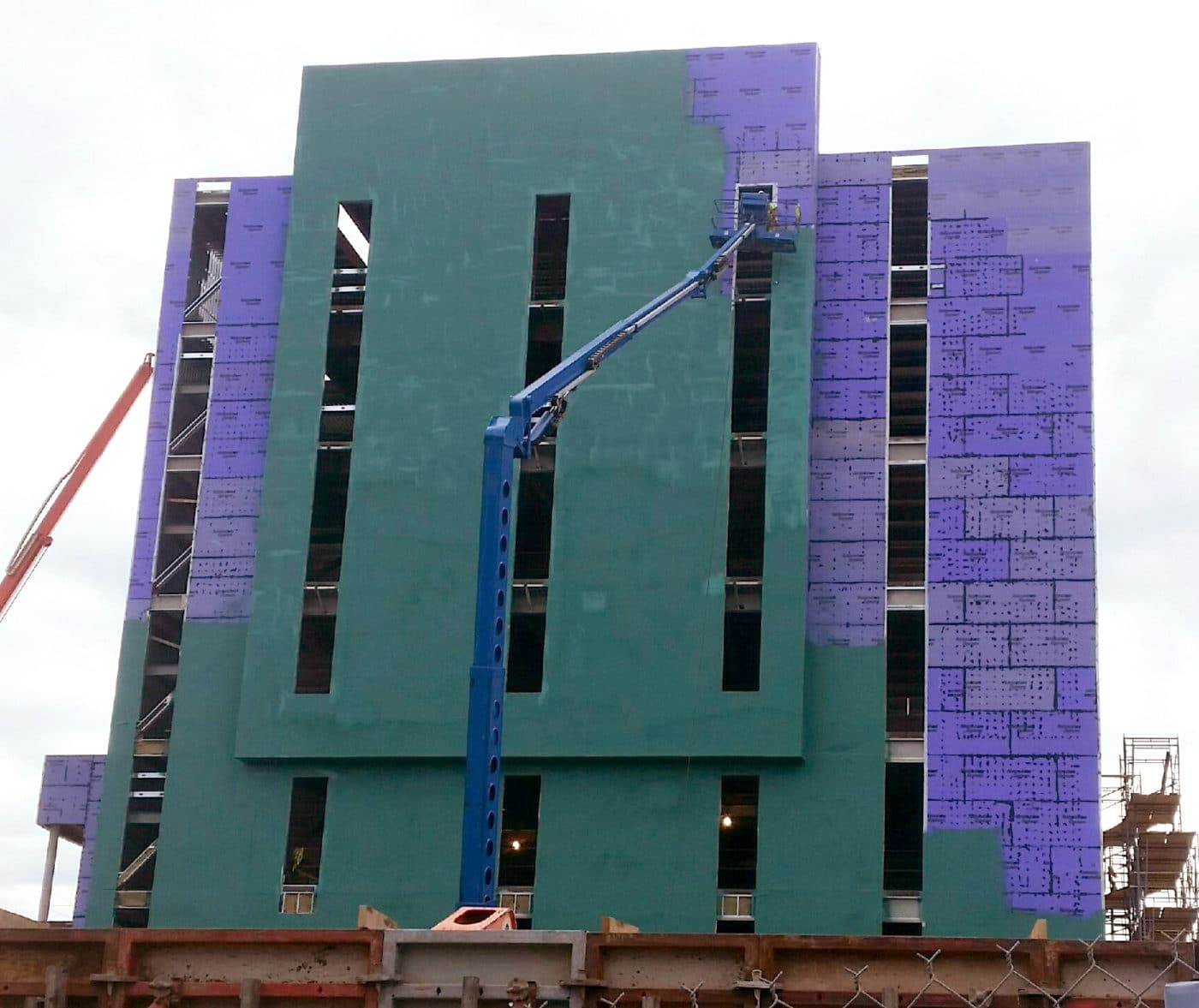
For commercial construction, industrial facilities, and large renovation projects in the Williston area, spray-applied air barrier systems deliver continuous, fully adhered coverage across the full wall assembly, including every penetration, structural transition, and framing detail where tape-detailed or sheet-applied systems leave gaps that Williston's sustained Arctic wind pressure will find and load throughout every heating season.
A spray-applied air barrier bonds directly to the sheathing substrate and cures into a continuous membrane that moves with the building through Williston's freeze-thaw cycles. For energy sector facility construction where the air barrier installation sits between framing and cladding in a compressed production schedule, spray application produces a complete, verified air control layer without the sequencing delays that tape-detailed systems require at complex geometry. In Williston's construction environment, where timeline adherence on energy sector projects has a direct financial impact, schedule reliability is not a secondary consideration.
Why Equipment Capacity Matters
on Williston Waterproofing Projects
Spray-applied foundation membranes and air barrier systems require consistent output pressure, correct material temperature, and even film thickness across large, continuous surfaces to perform as specified in Williston's extreme cold environment. Equipment that cannot maintain those variables during application in cold weather produces thin spots and coverage gaps that fail at the points of highest moisture and wind pressure stress, often within the first full frost season.
TCS runs multiple dedicated spray rigs and operates a 44-foot Featherlite commercial trailer, the Big Rig, that carries membrane materials, foam, lifts, and application equipment for large-scale Williston industrial and commercial projects in a single mobilization. For energy sector facility managers in Williston, where waterproofing and air barrier work must fit within a defined construction window before freeze conditions make application impractical, the single-mobilization readiness reduces both the moisture-exposure window during critical construction phases and the total mobilization cost.
"A general contractor TCS worked with on a large commercial build in the north Williston commercial corridor noted afterward that TCS was the first specialty envelope contractor on that project who arrived with material temperatures already managed for the ambient conditions and moved into continuous application from the first hour. The waterproofing and air barrier phases finished within the production window, the schedule required, without the setup delays that had pushed similar scopes past the weather window on previous projects he had managed in the Williston market."
See Air Barrier and Waterproofing Systems in Action
A look at how continuous air barrier membranes and deck waterproofing systems are installed to deliver the unbroken coverage Williston's Arctic wind exposure and frost cycling demand.
Air Barrier Installation
How a fluid applied air and vapor barrier membrane is installed at rough openings and across the wall assembly for continuous coverage.
Deck Waterproofing System
A look at a fluid applied membrane waterproofing system in action, the kind of seamless, fully bonded performance specified for foundations and below grade assemblies.
Why Williston Property Owners and Contractors Trust Technical Construction Solutions
Foam Technology Envelope Focus
TCS was built around foam and spray technology from its first day of operation. The application discipline that produces consistent spray foam insulation results carries directly into spray-applied foundation membranes and air barrier systems, avoiding thin spots before the second winter.
Moisture Pathway Diagnostic Checking
Every waterproofing project in Williston starts with identifying where moisture is entering and how it is moving through the building assembly before a product is recommended. That sequence prevents the wrong treatment from being applied to the right building surface.
Heavy Construction Field Background
Freddy Lewis's background in highway undersealing and below-grade infrastructure gives TCS technical credibility for foundation waterproofing on Williston's industrial facilities that general regional contractors cannot match across heavy Bakken sites.
Big Rig Mobilization Sizing Capacity
The 44-foot Featherlite commercial trailer gives TCS the material volume and operational readiness to complete large Williston projects in a single mobilization, eliminating the supply constraints and mid-project delays that underequipped crews generate.
Engineered for Bakken Frost Parameters
Every foundation waterproofing system and air barrier installation specified for Williston accounts for Bakken formation frost heave behavior, sustained Arctic wind pressure, industrial ground disturbance effects on sub-base moisture, and local heating demands.
On Time Schedule Verification
In Williston's energy sector environment, where construction phase delays carry measurable daily costs, and the weather window for exterior waterproofing work is limited by hard seasonal freezes, a contractor who delivers on schedule keeps your program intact.
Get a Free Waterproofing and Air Barrier Estimate in Williston, ND
A Williston building with open rim joist gaps, unsealed penetrations, and a foundation membrane that was applied without proper surface preparation is not partially waterproofed. It is losing the same battle every winter, with each frost cycle loading the same entry pathways and the interior damage accumulating in the wall assembly and below-grade spaces where it is not visible until the remediation scope has grown well past what a correctly specified original installation would have cost.
Start with a free estimate. One conversation is enough to assess the building envelope, identify where moisture is entering and how air infiltration is contributing to the problem, and give you a clear picture of what the right waterproofing and air barrier system will cost, no pressure, no obligation.